Photo: Rachael Adams
Article from Issue 364 – June 2025
give me all your honey – and everything else too.
GETTING CLOSE UP TO BEE-KEEPING IN MENORCA
The sky is blue again, with glorious fluffy clouds still lingering after the rain. I shut the crooked gate and power up the track towards the farmhouse on the hill. The ground is moist. Insects flit about the flowers, finally blooming after a dry winter. My book tells me they’re crown daisies, scarlet pimpernel, corn poppy, common catchfly and, somewhat less endearing perhaps, annual bastard-cabbage. I hear humming and notice bees near my feet. How nice, I think: they’ve come to get me.
I meet my friend at the car. She’s donning a huge white overall with an attached hat, elbow-length leather gloves, and stout rubber wellies. She hands me a pile of the same. For some reason, I hadn’t computed that getting up close would actually be part of learning about bees! I’m instructed to first close one zip to shut my neck into the veil, followed by another over it, followed by a Velcro flap over the top just in case. She stuffs a load of pine needles into her “smoker”- like a small metal watering can. Acid smoke fills the back of my throat. We gather up an assortment of primitive-looking tools and set off across the fields to the hives.
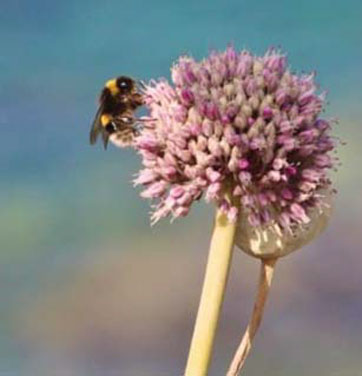
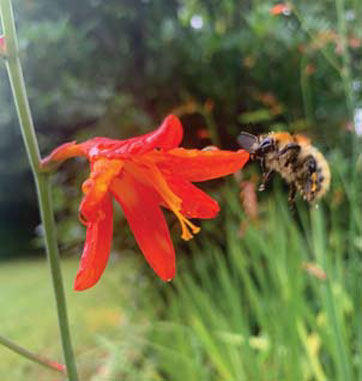
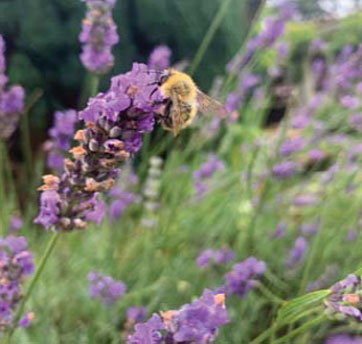
After a short while, having traipsed far enough away from the house, we cut through a gap in a stone wall and step over the rusting “warning: bees” sign lying face down in the grass. Apart from all the buzzing insect action, this is a fragrant and secluded part of our planet. There is a group of square, colourful boxes on raised benches in the middle of the field. The bees are out and about, flying as far as three kilometres away from their homes to forage for pollen, nectar and propolis. What they gather will be from a mixture of whatever flowers are here. This will make “multi-flower” honey. If it were to be rosemary honey, for example, the beekeeper would have to make sure only rosemary was present within their home range, and the honey is tested for its provenance in the lab.
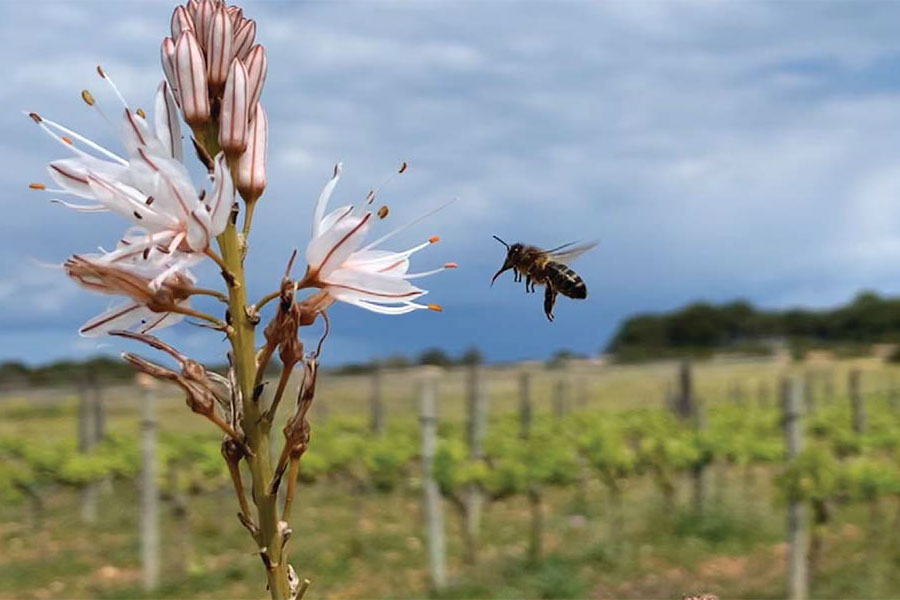
All of the bees flying around us are female. If one of them finds a lot of nectar-laden flowers, she zooms home to perform the “waggle dance”. This is a perfectly choreographed ritual consisting of circles, figure-eight and special noises to tell her colleagues where to find them. It can take a bee up to 2000 flower visits to fill her crop with nectar, a sweet-tasting sap full of sugar, vitamins and salts. Plants make it in glands called nectarines to attract pollinators to them. Many animals, like bats, hummingbirds and bees feast on nectar. The latter take some of the surplus home to store in combs in the hive, where it will be converted to honey.
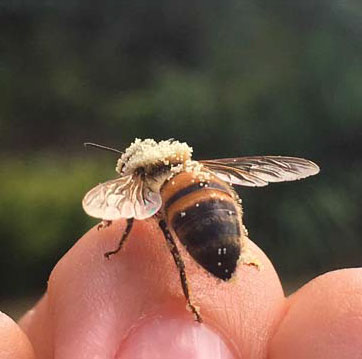
Besides nectar, pollen or sperm dust, from the male anthers of the plant, is also harvested. It’s gathered in the mouth and mushed into a paste before being stored in baskets on the rear legs for the flight home. These baskets are made from tightly-woven leg hairs. It can take a bee 20 return trips (with 2000 visits per trip) to fill one single cell in a honeycomb. The manual advises beekeepers to position their hives on flat ground as flying uphill carrying excess baggage is even more arduous a feat.
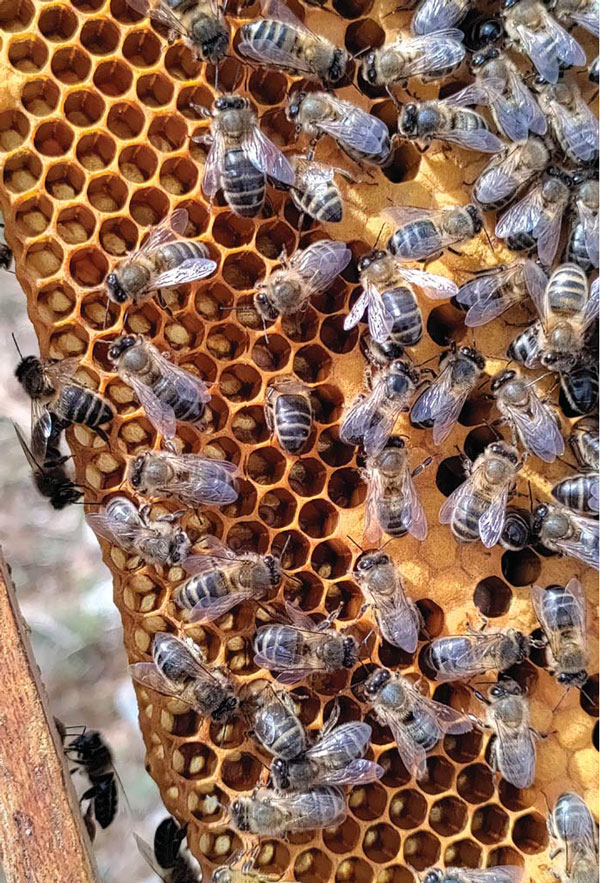
Back at base, the foraging bee scrapes her pollen droplets off into a cell with her other legs. A different “house bee” then regurgitates her enzyme-enriched nectar, and mixes it with the pollen. After a drying period, the bees “cap”, or seal the cell with wax secreted from specialised glands in their abdomen. This pap and bee vomit will eventually mature into delectable honey.
Importantly, while the insects suck up the nectar, the male pollen spores in their leg baskets are likely to come into contact with the female organs within the flowers, thus fertilising the plant. Even more importantly, this is the same process that fertilises many of our fruit trees and edible crops such as clover, cucumbers and sunflowers. Thus, honeybees and other pollinators, even the maligned mosquitoes (orchid pollinators), are crucial to our ecosystems. However, bees are in trouble because synthetic insecticides (such as neonicotinoids) poison them, and due to the loss of wildflowers and habitat that often accompany intensive agriculture or urbanisation.
While those concerns are certainly not an issue on this farm, sadly, after such a dry winter there aren’t many flowers out. My friend doubts the creatures will be able to make much honey for themselves, never mind spare any for the humans. What we steal is their larder for when there are no flowers or it’s too wet to fly. She’ll have to put some water out for them soon, she says, as they use it to mix the honey with.
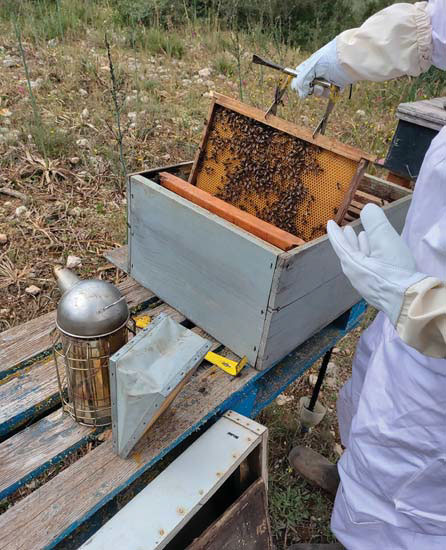
We near the first box and she hands me the smoker and instructs me to “blast through the holes at the entrance to the hive”. I check the Velcro around my neck nervously then give them what for with my ‘watering’ can. The smoke interferes with their senses so they can’t alert each other of danger, and attack. One source claims they believe their house is on fire so they eat all the honey and become too heavy to attack. Regardless, it’s best to open the lid from behind, away from the door. Leather gloved to the elbows; my friend carefully raises the roof off the hive. The humming intensifies, they’re instantly on my veils, inches from my defenceless, perforable skin.
There are 12 vertically hanging wooden panels to a box, and each one is crawling with furry, stripy bees, busily tending their combs. A hive generally houses 45,000 residents. We lift one out with a strange metal clasper, and I see perfectly hexagonal cells full of eggs, larvae and pollen. Some are sealed, some are still waiting, with hard-working hairy bottoms poking skywards. A few bees have orange-coloured pollen still in their baskets, while others have gathered yellow.
We try to find the queen. Massive, she should be breeding away somewhere near the centre of the box. She was impregnated for life after a couple of nuptial flights as a tearaway five-day-old. She can lay up to 1500 eggs a day. I shoosh some smoke as instructed, clutch the Velcro flap to my neck and peer closer. While we don’t find the queen, we do see a few bigger, rougher, peanut-shaped queen cells. These need annihilating — for if a new queen emerges, she’ll swarm and take half the colony with her.
As eggs, all of the bees are identical. What makes the larva grow into a queen, a drone (unfertilised male) or a female worker is the different food and length of time they get it, before being sealed into their cell to pupate and hatch into an adult. The queen becomes a queen because she’s fed strictly royal jelly, a white goop rich in vitamin A that’s produced by young worker bees from glands in their jaws. Larvae that get fed royal jelly for 2.5 days become female workers while those that get it for three become drones. After that they get a blob of “bee bread”, or a mixture of nectar and pollen, to last them until metamorphosis, and are entombed in their cell, by workers who seal it with wax caps.
Bees observe strict gender-divided roles. Adult males (drones) don’t do anything beyond impregnate the queen on her nuptial flight, use up all the food and keep the hive warm. They don’t have stings and can’t even feed themselves. They die upon mating because their “endophallus” (self-explanatory, really) snaps off when they ejaculate. In times of scarcity, the ladies barricade the door and let them freeze and starve to death outside. Not sure I blame them.
Female worker bees, on the other hand, start their lives as cleaners (of course). They tidy the cells and warm the hive, then graduate to nurse bees that feed bee bread to the larvae, then secrete royal jelly to feed the queen, feed the drones, make wax, guard the fort, and finally go out hunting for food. When flowers are bountiful, they’ll work themselves to death within six weeks.
Last of all the queen lays eggs. And that’s her lot. She produces secretions that are spread throughout the colony by her workers when they feed her. This tells everyone that she’s fit and strong and to proceed as normal. If, on the contrary, she was ailing somewhat, she’d stop producing her scent and the workers would build large queen cells and feed up some larvae to become queens that would replace her. Initially, the wax cells towards the inside of the hive are used for eggs, whilst those towards the outside are where the honey is stored. As the central panels are successively filled with eggs the ones storing honey are displaced towards the edges of the box. The more eggs the queen lays, and offspring she produces, the more space she needs to continue. Thus, more levels of boxes are added on top so that honey can be stored by the bees and then harvested by humans. The bees seal the cracks around the edges of the boxes with propolis, a resinous glue they make from tree sap (and which we also pinch). We slot the panel back in and check the next one.
In a good year, when there has been enough rain and flowers for the bees, some of the honey is harvested. The wax caps are sliced off and the honey is centrifuged out of the cells. It’s then left to filter out impurities. The wax is re-used, saving the bees from eating precious honey reserves to make more —unless we want candles too of course.
We also harvest the pollen – all the rage due to its vitamins, minerals and antioxidants. To do this, micro traps are set at the entrance to the hive so that the droplets get knocked off as the dutiful bugs fly in. It is, therefore, not remotely surprising, that we even harvest their poison – by getting the females to sting a silk cloth.
Happy that ours seem to be doing alright, we put the lid back on. First, I zap the ones on the edges with smoke so they move inside and don’t get squashed. We make sure to walk most of the way back to the farmhouse before taking our space suits off and dousing the smoker. More rain is forecast, so my pal might be lucky enough to gather some honey after all.